

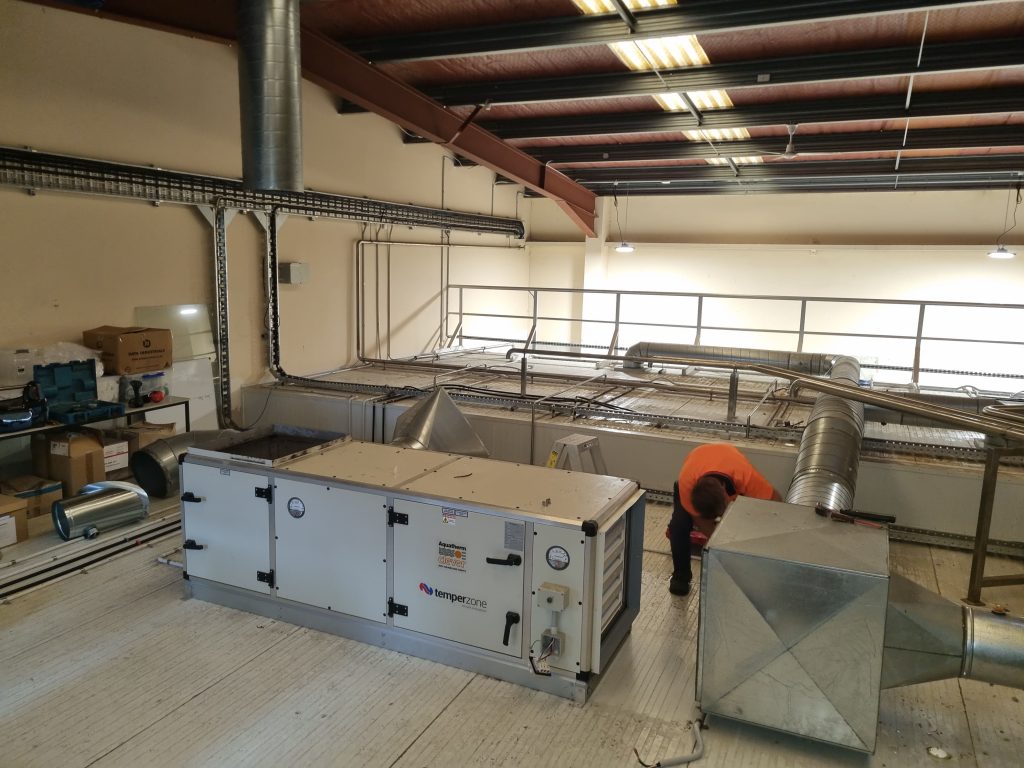
Climate control in a commercial building is not just about comfort. It directly affects how well your staff perform, whether your business meets its health and safety obligations, and how much you spend on energy each month. If your current system is outdated, undersized, or poorly maintained, the impact is likely costing you more than you realise.
Workplace Temperature and Productivity
Research consistently shows that indoor temperature has a measurable effect on concentration, decision-making, and output. MBIE guidelines recommend maintaining workplace temperatures between 18–22°C for sedentary work in winter and 19–24°C in summer, with relative humidity between 40–70%.
When conditions fall outside these ranges, the consequences go beyond discomfort. Overheated staff experience fatigue and reduced concentration. Cold environments lower manual dexterity and increase illness risk. Either way, the result is lower productivity and higher absenteeism.
A properly designed commercial air conditioning system maintains stable, consistent conditions across your entire building, regardless of occupancy levels, external weather, or internal heat loads from equipment and lighting.
Your Health and Safety Obligations
Under the Health and Safety at Work Act 2015, businesses in New Zealand have a legal obligation to ensure the safety of their workers, and that includes managing thermal comfort. While the legislation does not prescribe specific temperature limits, WorkSafe guidance makes clear that employers must identify, assess, and manage temperature-related risks so far as is reasonably practicable.
This means that if your workplace regularly becomes uncomfortably hot or cold and you have not taken steps to address it, you could be exposed to enforcement action or liability. Installing and maintaining an effective commercial air conditioning system is one of the most practical ways to meet this obligation.
Energy Efficiency and the Building Code
Energy costs are one of the largest ongoing expenses for commercial buildings, and HVAC systems are often the biggest single contributor. The New Zealand Building Code, specifically Clause H1 and verification method H1/VM3, sets out energy efficiency requirements for HVAC systems in commercial buildings.
These include minimum performance standards for compressors, fans, pumps, and ductwork, as well as requirements for zoning controls and energy monitoring in larger buildings.
Choosing a system that meets or exceeds these standards is not just about compliance — it is about reducing your operating costs. Modern commercial systems from leading manufacturers like Mitsubishi, Hitachi, Fujitsu, Panasonic, and Toshiba offer significantly better energy efficiency than older equipment.
Features like inverter-driven compressors, variable refrigerant flow (VRF) technology, and smart zoning controls allow the system to adjust output based on actual demand, avoiding the energy waste that comes from running at full capacity when it is not needed.
Choosing the Right System for Your Building
There is no one-size-fits-all solution for commercial air conditioning. The right system depends on your building’s size, layout, occupancy patterns, and operational requirements. A small retail unit has very different needs from a multi-level office block, and a warehouse with high ceilings and large openings requires a completely different approach to a hospitality venue.
This is where professional advice matters. A proper load assessment, taking into account floor area, glazing, insulation, solar gain, internal heat sources, ventilation requirements, and zoning needs, is the foundation of a system that performs well, runs efficiently, and lasts.
Talk to Us
At Comfort Group, we design, supply, install, and maintain commercial air conditioning systems for businesses across the Waikato region. Whether you need a new system for a build, an upgrade to existing equipment, or ongoing maintenance and IQP inspections for Building Warrant of Fitness, our team is here to help.